
Relevant Overviews
thecorrespondent.com

Whether we’re looking at The Correspondent, the world atlas or the national news, migration across the Mediterranean is depicted on maps as thick red arrows heading towards us. Far more than we realise, these arrows define how we view migration. Can that be changed?
www.kooslooijesteijn.net

ood UI design is all about guiding attention to what’s important. When making the right thing for the user the easy and obvious thing, you can’t ignore cognitive biases. After all, these biases are brain shortcuts that let us quickly and effortlessly make decisions and react to our environment.
gerrymcgovern.com
The illusion of cheap storage has encouraged by far the worst hoarding habits in human history.
www.linkedin.com
"understand the digital reader’s brain, and to get a couple of concrete writing tips for your next digital text." "Nothing can surpass a text when it comes to transforming abstract thoughts into concrete expression."
www.cmu.edu
The “known-new contract” is a linguistic concept used to describe how writers achieve cohesion between sentences by first presenting what readers already know (information previously presented) before introducing new information.
www.nngroup.com

Refrain from opening new browser windows. [...] Carefully examine the user’s context, task at hand, and next steps when deciding whether to open links to documents and external sites in the same or a new browser tab."
boagworld.com

"If you can write a half decent document you may be mistaken for thinking writing for the web will be easy. However, the web requires a focus of writing rarely needed elsewhere."
www.nngroup.com

Users pay close attention to photos and other images that contain relevant information but ignore fluffy pictures used to "jazz up" web pages.
wikis.ec.europa.eu
The Europa Web Guide is the official rulebook for the European Commission's web presence, covering editorial, legal, technical, visual and contractual aspects. All European Commission web sites must observe the rules and guidelines it contains. Web practitioners are invited to observe its contents and keep abreast of updates.
Do
design,
privacy,
web writing,
content creation,
web architecture,
writing for web,
accessibility,
style guide,
data protection
timo-m-lange.myhub.ai
Quick accessibility checklist (by European Commission)
timo-m-lange.myhub.ai
Writing tips from "Writing for the European Commission web presence"
www.niemanlab.org

“Daily political events consistently evoked negative emotions [which] predicted worse day-to-day psychological and physical health, but also greater motivation to take action aimed at changing the political system that evoked the negative emotions in the first place.”
lawsofsimplicity.com
Law 1 / Reduce - The simplest way to achieve simplicity is through thoughtful reduction.Law 2 / Organize - Organization makes a system of many appear fewer.Law 3 / Time - Savings in time feel like simplicity.Law 4 / Learn - Knowledge makes everything simpler.Law 5 / Differences - Simplicity and complexity need each other.Law 6 / Context - What lie…
Like
ux,
web design,
design,
content creation,
content structure,
user experience,
content management,
user behaviour
boagworld.com

"Designers love it, website owners want to fill it. Whitespace seems to be one of the most controversial aspects of design. Why then is it so important and how can we ensure it is maintained?"
www.theguardian.com

From now, house style guide recommends terms such as ‘climate crisis’ and ‘global heating’
theconversation.com

start to understand how we may need to balance social media with other more challenging, but ultimately more satisfying forms of communication
link.springer.com

"This article presents three experiments (total N = 1718) investigating the possibility of familiarity backfire within the context of correcting novel misinformation claims and after a 1-week study-test delay."
www.nngroup.com

Users have learned to ignore content that resembles ads, is close to ads, or appears in locations traditionally dedicated to ads.
www.nngroup.com

Summary: Design elements that appear similar in some way — sharing the same color, shape, or size — are perceived as related, while elements that appear dissimilar are perceived as belonging to separate groups.
gerrymcgovern.com
Gerry McGovern on skills needed for digital communication people. For example: - choose the right word to drive action; - make it easy finding content allowing users to complete a task quickly; - design for maintenance and evolution; - love metadata, be an information architect. I wished I had all of those.
www.nngroup.com

"Eyetracking studies show that users sometimes look at only a single result on a search-results page because that result is good enough for their needs."
www.niemanlab.org
www.niemanlab.org

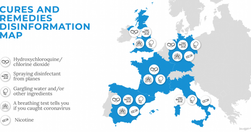
The growing stream of reporting on and data about fake news, misinformation, partisan content, and news literacy is hard to keep up with. This weekly roundup offers the highlights of what you might have missed.
medium.com

"Team members are the biggest reasons for our success ... Over 79% of employees who leave jobs, leave their managers. ... Leaders can find great power, influence, and success in making their team members feel important. "
knowyourteam.com

8 ways to help ease stress, improve morale, and make working remotely easier for your team.
www.forbes.com

"behavioral science provides several insights into habits we might adopt to increase our joy and happiness—almost instantaneously."
www.nngroup.com
People do not read online: "fundamental scanning behaviors remain constant, even as designs change."
www.wyliecomm.com

"The Huffington Post is the third most popular online news site, after only Yahoo! News and Google News. They must be doing something right!"
Do
web writing,
content creation,
clear writing,
readability,
sentence length,
writing for web,
reading score
www.nngroup.com

"Plain Language For Everyone, Even Experts" (video)
www.nngroup.com
"While it is important to keep key information easily accessible, the 3-click rule is an arbitrary rule of thumb that is not backed by data."