
Curated Resource ( ? )
Social media is turning into a freak show
Curated:
08/06/2026 from
www.natesilver.net/p/social-media-has-become-a-freak-show
my notes ( ? )
Nate Silver starts with a history lesson from the March 2014 re-launch of FiveThirtyEight, when "Publishers believed that maximizing “reach”, particularly as measured by the number of monthly unique visitors, was the key to success", which meant gaming Facebook's News Feed algorithm. That didn't work, as facebook and publishers were "locked into a zero-sum, adversarial relationship... Facebook wanted readers to stay within its walled garden" while Publishers saw Facebook as "a miserable, liminal space where you’d hopefully spend as little time as possible before booking a one-way ticket out of town."
FiveThirtyEight "never got much traffic from Facebook... [which] tended to reward emotional sentiment ... exactly the opposite of our editorial goals ... we wanted to encourage cool, analytical, nuanced reactions to things that people are ordinarily quite passionate about".
This got me thinking about how the European Commission changed its communications approach during that decade, when it moved from (trying to] clearly communicate European added value ("here are the facts") to get emotional engagement with the European project from European citizens ("love me!"). How a political project communicates affects the political project by changing the way people see it.
Back to FiveThirtyEight: when an article did go viral, the resulting "traffic was almost worthless". Twitter was better: mre engagement, despite being smaller, as it "rewarded newsworthiness, subject-matter expertise, and a certain kind of nerdy and snarky but relatively cerebral argumentativeness", which explains why the Brussels bubble seemed more at home there. But since then Twitter became "more partisan, less pluralistic, and dominated by quote-tweets and dunks... much more woke. The enforcement of groupthink was rigid, not unlike what Bluesky has become today", so for his (substack) business "social media is a secondary source ... trending toward being a tertiary one — and that this is probably also true for most other publishers", although he does provide some caveats.
But "while Facebook is now almost completely irrelevant to the political discourse, that isn’t quite true for Twitter... [where] the recent decline has been more gradual... But what does that remaining traffic consist of?"
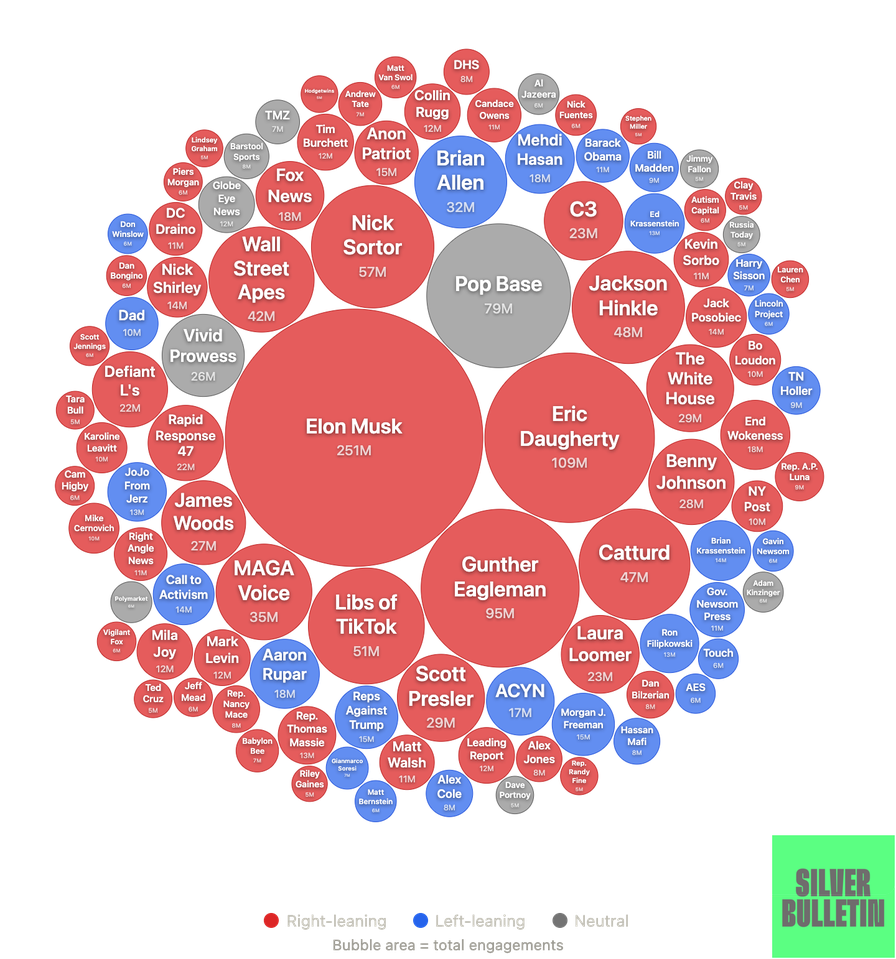
The main image shows "the Twitter accounts with the most engagement so far in 2026... Twitter has become extremely right-leaning... the top accounts are of incredibly low quality... “Catturd” literally gets far more engagement than the New York Times... the liberal-leaning accounts that remain prominent on Twitter aren’t much better."
He then analyses "social media and web publishing business models ... as ecological systems", particularly the selection effects, and how successful models reflect more "the quirks of the algorithm rather than deeper truths about human nature or what people really want to read... Few of the businesses that were considered hot shit during the mid-2010s are thriving today."
He points out his own biases, the way that what's hot on "Substack often reflects a correction from ... the mainstream media, who often chase away their best customers in an effort to fight the last war or to pursue their own political or ideological objectives", and that Bluesky seems to be shrinking, although he doesn't mention the Atmosphere at all.
But "Twitter feels like a ghost town ... Links to external websites are substantially punished... rewards from still having 3 million followers can be surprisingly marginal... The New York Times has 53 million followers, and yet its tweets often produce only a few hundred likes, retweets, and replies even when they reveal urgent, breaking news."
He then reaches back into ecological science for the "island effect... when there’s a lack of competition in an isolated environment, strange things tend to happen", so Twitter now looks like two Komodo dragons locked in combat, except they are the Catturd and the Gavin Newsom Press Office accounts.
Read the Full Post
The above notes were curated from the full post www.natesilver.net/p/social-media-has-become-a-freak-show.Related reading
More Stuff I Like
More Stuff tagged communications , ecology , eu , facebook , media , social media , twitter
See also: Communication Strategy , Online Strategy , Social Media Strategy , Content Creation & Marketing , Social Web , Media , Politics , Communications Strategy