
Curated Resource ( ? )
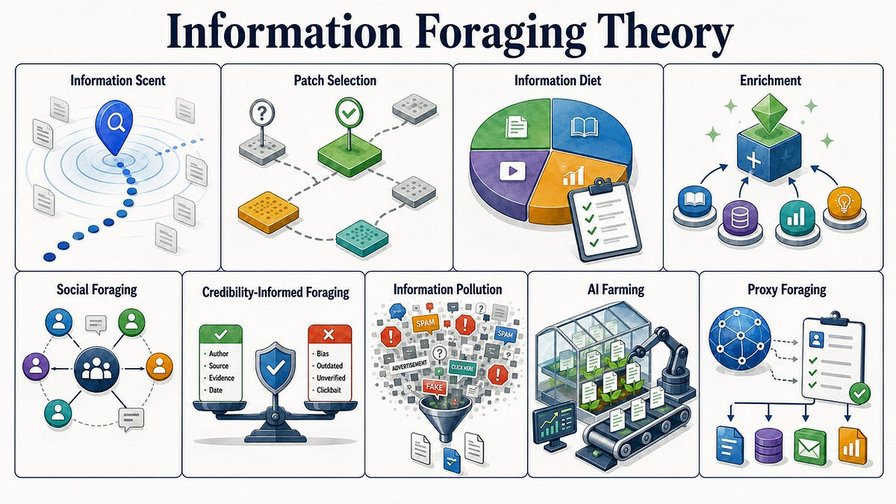
Information Foraging Theory: Why Users Hunt, Snack, Leave, and Farm Content
Curated:
09/09/2026 from
jakobnielsenphd.substack.com/p/information-foraging
my notes ( ? )
This article covers these 9 aspects of Information Foraging Theory (IFT).
Users Are Informavores, and Informavores Are Animals
In 1983, the psychologist George Miller coined the word informavore for a creature that survives by consuming information, the way other creatures survive by consuming food. A dozen years later, Peter Pirolli and Stuart Card at Xerox PARC took the word literally. Their 1995 CHI paper, Information Foraging in Information Access Environments, and the full theory published in Psychological Review in 1999, proposed that people seeking information behave like animals seeking food, and that the same mathematics predicts both. (Card is the theoretician of our field; see my UX Hero profile of Stu Card.)
Users hunt for information the way animals hunt for food.
The mathematics came from biology. Optimal foraging theory (OFT) started with Robert MacArthur and Eric Pianka’s 1966 paper, On Optimal Use of a Patchy Environment, got its sharpest tool in Eric Charnov’s 1976 marginal value theorem, and was codified in David Stephens and John Krebs’s 1986 book Foraging Theory. OFT asks one question: given that finding and eating food costs time and energy, how should an animal behave to maximize its net energy intake? Evolution has had a few hundred million years to run this optimization, so animals are frighteningly good at it. Pirolli and Card’s informavore version swaps energy for value: people adapt their information-seeking behavior to maximize the rate of gain of valuable information per unit cost of interaction. Everything else in the theory follows from that one swap.
Users forage for information to maximize the value of what they find relative to the time spent.
The theory explains why Google made users leave websites faster in 2003, and it explains the AI era just as well: zero-click answers, information farming, foraging agents, and the new plague of information pollution, in which AI slop counterfeits the scent of quality the way floating plastic counterfeits the smell of food for seabirds. Same animal, new savanna.
The consequences are the interesting part, because a theory is a machine for making predictions: which links users will click, how long they will stay on a page, when they will give up, and why a better search engine is bad news for your site’s dwell time. Users don’t do the math, of course. Neither does a hummingbird. Both behave as if they did, because behavior that squandered effort was selected out long ago. Users are selfish, lazy, and ruthless in applying their cost–benefit analysis. That’s simply the survival strategy of a very successful species.
Animals (and users) exhibit optimal behavior without knowing the theory or using a formula.
Users optimize what’s in it for themselves, not how the designer would like them to behave.
I consider information foraging theory (IFT) the single most important theoretical concept for explaining user behavior in information-rich environments. Not the most cited: a bibliometric review by Williams Nwagwu of the University of Ibadan, Thirty-Two Years of Research on Information Foraging Theory (2024), found 449 papers by 933 authors from 1992 to 2023, about 14 per year, peaking at about 35 papers a year around 2012–2013 and declining after 2017. Pirolli himself wrote 30 of them.
The foundational research paper, Pirolli and Card’s Information Foraging (Psychological Review, 1999), has 3,699 citations on Google Scholar, whereas their original CHI 1995 paper introducing the theory has only 776 citations. If these had been my papers (I wish), they would rank as numbers 8 and 31, respectively, on my list of Google Scholar citation counts.
Those are modest numbers for a theory applied every day by every person who has ever rewritten a link label. IFT is used far more than it’s cited, which is the thankless fate of theories that become common sense. Why do I rank it above Fitts’s law and the Gestalt principles? Because it explains not only what users do but why, from first principles, and because it has survived three revolutions in the information environment (the early web, the Google era, and generative AI) without any change to its core. Let’s see how.
Information Scent = Sniffing Before Clicking
Pirolli and Card defined information scent as the imperfect perception of the value, cost, or access path of an information source, obtained from proximal cues such as link labels, citations, or icons. In plainer words, as I put it in my article on information scent: scent is the user’s estimate of how much value a path will deliver, formed entirely from the cues visible before committing to that path. The key word is before. Scent is a prediction, made at the fork in the trail, on the basis of a few words and pixels.
Links are forks in the user’s trail. Poor information scent causes link roulette, where users click links without knowing where they lead. Just as in casino roulette, the average player loses at link roulette and leaves the site.
Animals live and die by such predictions. A turkey vulture can’t see a dead deer under a forest canopy, so it smells it: the bird detects the ethyl mercaptan given off by carrion at a few parts per trillion. In the late 1950s, the ornithologist Kenneth Stager proved this after a Union Oil employee mentioned that vultures gathered wherever a gas pipeline leaked: the company added ethyl mercaptan to its odorless natural gas to make leaks noticeable, and to a vulture the additive smells like carrion. The vultures were following an honest cue to a dishonest patch. (Hold that thought until we get to AI.) A predator rarely sees its prey until the chase begins. It sees hints, weighs them, and commits.
Web users sniff the same way. In my studies, users judged links on roughly the first 2 words of the label, and when those leading words were well chosen, most users correctly predicted where a link would take them. A vague label or a mystery-meat icon emits no scent, and a link with no scent is a link that doesn’t exist. And the scent must keep strengthening along the trail. A click that lands on a page that doesn’t smell the way the label promised triggers boomerang browsing: users return to the previous page and try something new. (Repeated boomerangs become bounces, as users leave sites with poor information scent.)
Boomerang browsing is what happens when the user hits a dry spot and returns to the starting point to try another link, hopefully a juicier one. But users will throw only so many boomerangs before giving up. (Muse Image)
The concept proved so operational that Ed Chi and colleagues at PARC turned it into software: their 2001 CHI paper, Using Information Scent to Model User Information Needs and Actions on the Web, computed the scent of every link on a site from the surrounding words and predicted which pages users would visit, and Wai-Tat Fu and Pirolli’s SNIF-ACT model (2007) reproduced real users’ click sequences from scent alone. A scent you can compute is a scent you can engineer.
Information scent is the most important of the IFT concepts for designers; read my full article about information scent for the details.
Patch Selection = Where the Berries Are
Food is patchy. Berries grow on some bushes and not on the bare ground between them, so a bear’s day consists of within-patch time (eating berries) and between-patch time (walking to the next bush). Inside a patch, the gain curve flattens: the first minute on a bush yields a mouthful every few seconds; the fifth minute yields the occasional shriveled berry the bear has to root out. When should the bear move on? Charnov’s marginal value theorem gives the answer: leave the patch when the rate of gain within it drops to the average rate of gain for the environment as a whole. And the average rate depends on how long it takes to reach the next patch. When travel is cheap, leave early. When travel is expensive, stay and pick the shriveled berries.
Animals obey this theorem with embarrassing precision. Richard Cowie’s 1977 experiment with great tits in an aviary made the birds open sealed cups to get mealworms; when the lids were harder to remove (a stand-in for longer travel time), the birds stayed longer at each cup, exactly as Charnov predicted. Foragers learn the environment’s average and then hold every patch to that standard.
The birds ate more from each cup when the lid was harder to open. Web designers shouldn’t copy the hard lids: with so many other websites a click away, users won’t even bother entering a site that’s hard to get into.
Websites are patches. So are pages within a site, search-result pages, and, today, chatbot answers. A user extracts value from a page at a diminishing rate: the headline and first paragraph deliver most of it, the rest delivers dregs. Let’s do the arithmetic for a user named Alice, who can extract 10 useful facts from a page in the first 30 seconds, 3 more in the next 30, and 1 in the third half-minute. If reaching the next promising page costs her 10 seconds, the theorem says she should leave after 30 seconds, when her rate over the visit (10 facts in 40 seconds) still beats what the next 30 seconds would yield. If reaching the next decent page costs 2 minutes, as it did in the search-engine dark ages of 1998, she should stay a full minute and strip the bush of those last 3 facts. Cheap travel between patches halves the visit. That’s the whole story of the Google era, and of the AI era too.
Information Diet = Deciding What’s Worth Eating
The third model is about selectivity. Every prey item has a profitability: energy gained divided by handling time, the time it takes to catch, subdue, open, and chew it. OFT’s diet model says a forager should rank prey by profitability and eat down the list only as far as it pays. The surprising prediction, confirmed many times, is that whether a low-value item makes it into the diet depends only on how common the high-value items are, not on how common the low-value items are. When good prey is abundant, the poor prey is ignored no matter how much of it is walking around.
Biology confirms this ruthlessly: bluegill sunfish ignore smaller water fleas when larger ones are abundant, and northwestern crows select only the largest whelks to drop on rocks, calculating the exact height needed to minimize flight effort per calorie. Small whelks aren’t worth the flight. Lions don’t chase mice.
Bluegills go for the largest prey when prey is plentiful; users skip mediocre pages when good ones abound.
Users run the same calculation on content. The profitability of a page is the value it delivers divided by the time it takes to extract that value, which is why a 300-word answer beats a 3,000-word essay that contains the same answer, and why the diet model doubles as a theory of why users don’t read. The diet prediction has a nasty implication for content producers: as the supply of good content grows, mediocre content drops out of everybody’s diet, however plentiful it is. In 1996, users read mediocre pages because that was all the web served. In 2026, nobody reads a mediocre page, and the torrent of pages extruded each day makes no difference to that decision.
A 300-word answer beats a 3,000-word essay containing the same answer; the diet model explains why users don’t read. (Yes, I know that this is a 7,000-word article: it’s highly nutritious for people who need to understand information foraging, but that’s less than 1% of users.)
Before we move on to what happens when the environment changes, here’s a table of the parallels between animals foraging for food and humans foraging for information:
Why Google Made Users Leave Your Site Faster
In 2003, I claimed that information foraging explains why Google makes people leave your site faster. At the time, the claim struck many web managers as perverse. Google had become good enough that users could find good sites, so surely they’d settle in and stay? The marginal value theorem said the opposite, and the theorem was right.
Two decades ago, I used to lecture the true believers in sticky content that Google made people leave websites. The theory proved right.
Recall the great tits: harder lids, longer stays. In the 1990s, the web had very hard lids. Most websites were dreadful, search engines coughed up garbage, and the cost of finding the next patch was high. So users stayed put and picked shriveled berries; they tolerated bad sites because leaving was worse. Google flipped the equation by ranking results on quality. The cost of reaching a good patch dropped to one query and one click, the environment’s average rate of gain shot up, and every patch had to clear a higher bar to hold a visitor. The easier it is to find good patches, the quicker users will leave any given patch. That’s not fickleness. That’s Charnov.
The behavioral result was what I called information snacking: short visits, quick answers, many sites, little loyalty. My advice in 2003 was to stop fighting it. Support short visits; be a snack. Answer the question in the first screen, because you’re competing with the visitor’s next search, not with the visitor’s patience. Now, 23 years later, the number of sites that still open with the billboard trifecta of a slogan, a hero image, and a video nobody asked for is a monument to how hard this lesson is to learn.
Despite my advice to “be a snack,” sites still open with a slogan, a hero image, and a video nobody asked for.
What makes 2003 relevant again is that the same theorem is now working against Google itself. A Pew Research Center analysis of the browsing records of 900 American adults in March 2025 found that about 1 in 5 Google searches produced an AI summary, and that users clicked on a regular search result in only 8% of those visits, versus 15% when no summary appeared. Fully 26% of visits with an AI summary ended the browsing session outright, compared with 16% without. The AI answer is a patch with a fast gain curve and zero travel time, so users eat it and go home. On my own site, AI systems scraped 207 pages for every visitor they referred in October 2025. Google made users leave your site faster. AI keeps them from arriving at all.
With an AI summary on the page, clicks on results fell from 15% to 8%, and 26% of sessions ended right there.
Enrichment: The Forager Who Farms (Pirolli’s 2007 Extension)
The three models above (scent, patches, diet) cover a forager who takes the environment as given. But Pirolli and Card noticed something in their early experiments with Scatter/Gather, a browser that clustered a document collection into topical piles the user could re-cluster at will: foragers spend time changing the environment. They filter, sort, cluster, and organize, none of which yields a single berry; the payoff comes later. The 1999 paper added this as a distinct activity, which Pirolli and Card called enrichment: investing time now to modify the information environment so that later foraging is more profitable. The marginal value theorem still holds, with an amendment: enrichment lengthens the between-patch period (you’re not eating while you build), so it pays only when the improved gain inside the enriched patches outweighs the time spent enriching.
Leafcutter ants have farmed fungus for 50 million years; enrichment means investing effort now for a better harvest later.
Pirolli’s 2007 book, Information Foraging Theory: Adaptive Interaction with Information, carried this idea much further, toward information cultivation, or enhanced foraging: situations in which people and organizations actively cultivate information environments by tagging, annotating, rating, and structuring content for future retrieval, instead of merely searching a landscape somebody else made. The social web of the mid-2000s was Pirolli’s laboratory. Social bookmarking sites such as del.icio.us let millions of users tag pages for their own later use, and as a side effect the tags became scent for everyone else. (A note on terminology: Pirolli’s own word was enrichment. Leif Azzopardi and Adam Roegiest, whose 2026 paper we’ll get to, present information farming as their coinage, and it’s the better metaphor, so I’ll use it.)
Animals farm too, and they’ve been at it far longer than we have. Leafcutter ants have cultivated fungus gardens for about 50 million years, according to Ted Schultz and Seán Brady of the Smithsonian; the ants fertilize the fungus with chewed leaves and weed out competing molds. Squirrels scatter-hoard acorns in hundreds of caches and retrieve them months later, an enrichment strategy with a familiar failure mode: they forget where a good fraction of the acorns are, which is how oak forests get planted. Every one of us with 2,000 unread bookmarks is a squirrel.
That failure mode is the theorem talking. Enrichment pays only for patches you’ll revisit, yet users tag pages they’ll never return to, because the cost of clicking Save is small and the benefit is imaginary. The practical prediction: enrichment tools pay off for repeat foragers (professionals working a domain for years) and are dead weight for one-time visitors. A consumer website that nags first-time visitors to create folders is asking a bear to plant berry bushes on the way through.
Social Foraging: Waggle Dances and Web Waggle
Bees don’t forage alone. A returning honeybee performs the waggle dance that Karl von Frisch decoded (a shared Nobel Prize in 1973) to tell the other bees where to find pollen. Ants lay pheromone trails that other ants reinforce; in the double-bridge experiment by Simon Goss and colleagues in 1989, Argentine ants converged on the shorter of two paths to food without any individual ant knowing the geometry. Peter Ward and Amotz Zahavi proposed in 1973 that communal roosts are information centers where unsuccessful foragers follow successful ones out the next morning, and studies of hooded crows and griffon vultures have since confirmed that naive birds do follow the well-fed.
Pirolli extended IFT to groups in his 2007 book and formalized it in a 2009 CHI paper, An Elementary Social Information Foraging Model. The model contains two opposing forces. Hints from others (their trails, tags, and remarks) diversify what the group can find, so a group outperforms an individual. But as the group grows, foragers duplicate effort, drift into each other’s patches, and converge prematurely on whatever the loudest member found, so returns diminish. The two forces imply that the optimal group size is moderate: big enough for diversity, small enough to limit interference. Anyone who has watched a 12-person Slack channel hunt for a document knows the interference term is real.
The idea is older than the formalization. A 2002 CHI student poster by Stephen Schultze of Calvin College, A Collaborative Foraging Approach to Web Browsing Enrichment, described a prototype called Web Waggle (yes, after the bees) in which users kept shared lists of pages and the system suggested pages from users with overlapping lists. In a 4-month trial, 15–20 students became regular users, and their lists held 776 links to only 472 distinct pages: the community was converging on the same patches. Schultze also named the disease that killed most such systems, the critical-mass problem. A hive with 3 bees dances to an empty floor.
The most rigorous recent test comes from Shahnewaz Leon and Sandeep Kuttal of North Carolina State University, whose CHI 2026 paper, Where Will They Click Next? A Social Foraging Model for Collaborating Teams, built the first computational model of social foraging that predicts moment-to-moment behavior. They put 30 programmers in 10 three-person teams and gave each team 45 minutes to debug a 3,000-file open-source bibliography manager while talking on a voice call. Their model, PFIS-T, treated two kinds of social cues as scent: implicit cues (files a teammate had just opened) and explicit cues (files a teammate mentioned aloud, such as “I bet the problem is in drawTriangle”). Adding social scent to the best individual model cut the share of navigation steps the model couldn’t predict at all from 34% to 21% on average, and to 18% in one talkative team; the correct next file appeared in the top 20 suggestions 71% of the time versus 64% without social cues. Teams that talked and overlapped more gained more. Silent teams gained nothing, which is the model working exactly as designed.
Two findings deserve attention from anyone designing collaborative tools. First, implicit cues (what teammates did) helped steadily, while explicit cues (what teammates said) were sparse and sometimes wrong; a confident teammate pointing at the wrong file made predictions worse. Second, the model performed best when it kept a strong exploration floor and required little consensus before surfacing a teammate’s trail: follow the herd a bit, but not into the ravine. That’s Pirolli’s interference term, measured.
The design translation: show social scent (“2 teammates opened this”), explain why an item is highlighted, keep it ambient, and let users dial the crowd’s influence up or down. The study has the usual lab limitations (students and early-career developers, a single bug, 45 minutes), but it’s the first time social IFT has been made to predict instead of describe, and I’d bet the pattern transfers to any job where three people stare at the same haystack.
Credibility-Informed Foraging: Not Every Berry Is Safe
A forager that maximized energy intake without regard to poison would be dead within a season, so evolution built credibility detection into the foraging system. Rats are the classic case. A wild rat nibbles a tiny amount of any novel food and waits; if it feels sick hours later, it will never touch that flavor again. John Garcia and Robert Koelling’s 1966 experiments established this one-trial taste aversion, which still frustrates every pest controller who tries to poison a rat colony (the survivors become bait-shy for life).
Rats nibble, wait, and never touch a bad flavor again; one-trial taste aversion is the oldest credibility filter.
Lincoln Brower showed in 1969 that a blue jay that vomits after eating a monarch butterfly rejects every monarch on sight thereafter, which is why the monarch’s orange is a warning label, not a decoration. Rats even consult each other: Bennett Galef and Stephen Wigmore found in 1983 that a rat prefers a food it has smelled on a nest-mate that ate it and came home fine, and Galef’s later work traced the cue to the nest-mate’s breath. A recommendation from someone who ate it and lived is the oldest credibility signal there is.
Human foragers need credibility signals just as much, and the theory has been extended to provide them. Yassine Drias of the University of Algiers and Gabriella Pasi of the University of Milano-Bicocca proposed credible information foraging on social media in 2020: a system that generates surfing paths through a social graph while scoring each step for both relevance to the user’s interests and the credibility of the source, and they evaluated it on Twitter data. Drias and co-authors then scaled the foraging engine in their 2022 paper on enhanced elephant herding optimization, which deserves a paragraph purely for its biology.
Elephants live in matriarchal clans that roam home ranges of 15–3,700 square kilometers and split off when food runs short. The algorithm mimics this: clans of virtual elephants forage through a social graph of 1.41 million tweets, each elephant following information scent (the increase in similarity between the next post and the user’s interests), the matriarch pulling her clan toward the best path found, and a stagnating clan migrating to a fresh territory. Dividing the graph into 55 topical territories raised the average relevance of the paths found from 0.65 to 0.77 while cutting response time from 26.5 seconds to 0.9 seconds.
It’s impressive engineering, but note what the elephants are optimizing: similarity to the user’s existing interests. A foraging engine that maximizes scent alone will lead you, with great efficiency, into an echo patch stocked with the most on-topic lies on the network. Credibility has to be in the objective function, as Drias and Pasi’s earlier version attempted, or the herd will trample straight into the swamp. The same warning applies to recommender systems built purely on engagement metrics.
The human data are sobering. Matthew Hattersley and co-authors reported in Cognition in 2022 that people who endorse implausible conspiracy theories sample less information before deciding in a foraging task: they abandon the patch early and dine on the story they brought with them. Belief is a kind of scent, and it’s addictive. The design consequence follows from the diet model: credibility cues must be as cheap to perceive as relevance cues, or the handling time of checking them will push them out of the diet. Author, date, source, and evidence must sit at the point of decision, next to the link, not three clicks away on an “About” page nobody visits.
Information Pollution: When the Scent Lies
Physical environments get polluted, and it’s instructive to ask how animals cope, because their foraging systems evolved in a world with plenty of dangers but no plastic. Against ancient dangers, they cope well. Poison is handled by taste aversion. Predators are handled by what John Laundré and colleagues named the landscape of fear after wolves returned to Yellowstone in 1995: elk kept feeding, but they fed less in the places where wolves could ambush them, trading a few mouthfuls for a lower chance of becoming a meal themselves.
Even fire, the ultimate blighted patch, has been around long enough for animals to have adapted. They flee the flames, but many return to exploit the burn: fire beetles of the genus Melanophila carry infrared sensors that detect a forest fire from many kilometers away, so they can lay eggs in freshly burned wood before the competition arrives. In northern Australia, black kites and brown falcons pick up burning sticks and drop them in unburned grass to flush out prey, as Mark Bonta and co-authors documented in 2017 after Aboriginal people had reported it for generations. A burned patch is a dangerous patch for a day and a rich patch for a season, and evolution has taught its foragers the schedule.
Against novel pollution, animals fail, because there was no selection pressure to detect it. Martin Schlaepfer and co-authors called these failures evolutionary traps in 2002: a cue that reliably indicated a good patch for millions of years now points to a deadly one, and the animal can’t tell. Mayflies lay their eggs on asphalt roads because the surface polarizes light the way a pond does, as György Kriska and colleagues showed in 1998.
In the closest parallel to our problem, Matthew Savoca and colleagues at UC Davis found in 2016 that marine plastic smells like dinner: algae that grow on floating plastic release dimethyl sulfide, the very compound that petrels, shearwaters, and albatrosses have used for eons to locate the krill that eat algae. Species that hunt by that scent were nearly 6 times more likely to have swallowed plastic than species that don’t. The plastic doesn’t attack the bird. It counterfeits the bird’s scent.
Marine plastic smells like dinner to seabirds; AI slop smells like expertise to users. Pollution kills by counterfeiting scent.
Now transfer the argument. Human information foragers acquired their scent detectors culturally, over roughly 25 years of the web, and the detectors were calibrated for an environment in which fluent prose, a confident expert tone, a clean layout, footnotes, and a hundred customer reviews all cost real effort to produce and therefore signaled real value. Generative AI has driven the cost of every one of those cues to zero. Scent spoofing, the manufacture of quality cues without the quality, is the plastic of the information ocean, and users are the shearwaters. Content farms did it crudely with keywords; AI does it fluently, at industrial scale: scent laundering. The informavore trap is set.
Scent spoofing isn’t new, only cheap. Around the year 985, Erik the Red, exiled from Iceland, discovered a glacier-covered island and named it Greenland; the saga records his reasoning that people would be more eager to go there if the land had an attractive name. It worked. The sagas say 25 shiploads of settlers followed the scent, and the colony held on for more than 400 years before the climate turned too cold for Scandinavian farming. Users have been falling for good labels on bad patches for a millennium. What’s changed is that a saga-worthy label now costs a tenth of a cent.
Ecology suggests the antidotes as well. First, taste-testing: rats survive by nibbling before committing, and interfaces should let users sample a source cheaply (previews, expandable summaries, visible excerpts) before investing the full handling time. Second, warning coloration: the monarch’s orange works because it’s honest and universal; provenance labels and disclosure of AI generation are our aposematism, as biologists call warning coloration, and Azzopardi and Roegiest are right to compare them with the food labels (organic, non-GMO) that let shoppers forage in a polluted supermarket. Third, the nest-mate’s breath: social credibility from people who consumed the source and lived, which is what a real review delivers and a farmed review counterfeits. Fourth, the landscape of fear: users avoid whole regions of the web they’ve learned to distrust, and that exodus to walled patches, where somebody else has filtered out the plastic, carries a hidden cost that the next section takes up. Table 2 summarizes the parallels.
This raises the question that will decide the next decade of trust design: what scent can’t be counterfeited? Amotz Zahavi provided the answer in 1975: the handicap principle, which says a signal stays honest only when it’s too expensive to fake, as with the peacock’s tail or the decade-old Internet domain. Every cue the web taught users to trust (fluent prose, footnotes, confident tone, a hundred glowing reviews) has had its production cost driven to zero, making each of them a peacock tail made of paper. The diet model predicts a flight to costly signals, and it hands designers a test: invest in cues whose cost can’t go to zero. A reputation is a handicap AI cannot grow overnight.
AI Farming: From Berry Picking to Berry Growing
Leif Azzopardi of the University of Strathclyde and Adam Roegiest of the legal-AI company Zuva argue in their 2026 CHIIR paper, Information Farming: From Berry Picking to Berry Growing, that generative AI is doing to information seeking what the Neolithic Revolution did to eating. Hominins got their food by hunting and gathering for millions of years; around 10,000–12,000 years ago, some of them started planting it.
Information farming: plant a prompt, prune, weed, and harvest. Foraging finds information that already exists; farming grows information that never existed in any patch.
Marcia Bates’s berrypicking model (1989) and Pirolli and Card’s foraging theory describe users as gatherers moving from patch to patch. With a large language model, the user instead plants a seed (the prompt), grows a crop (the response), prunes it (“shorter”), weeds it (“that citation doesn’t exist, remove it”), fertilizes it (retrieval augmentation, pasted documents), harvests it (a table, a summary), and saves seeds for replanting (a reusable prompt). Azzopardi and Roegiest list 12 such farming operations, and the mapping is uncannily tight. The forager adapts to what is found; the farmer shapes what is grown.
The gains are real, and I don’t want to undersell them. Farming yields more per hour, yields it more predictably, and produces information that didn’t previously exist in any patch, which foraging by definition can’t do. But Azzopardi and Roegiest are equally clear about the risks, and they read like an agricultural history: monocultures (everybody harvesting from the same 3 models), crop failures (hallucinations at scale), soil exhaustion (models trained on their own detritus), and sharecropping, where the farmer works the plot but the platform owns the land.
They also cite early evidence that farmed information is less nourishing than foraged information: Nataliya Kosmyna of MIT and co-authors measured weaker neural engagement and poorer recall among the essay writers in their 54-participant study who leaned on ChatGPT, a condition they termed cognitive debt. The first farmers were shorter and sicker than the hunter-gatherers they replaced. Farming won anyway, because it scaled.
IFT explains the shift without modification. Run it through the three foundational models:
- Scent. In a chat, the system manufactures the scent, and the answer arrives before the user can sniff it. There’s no fork in the trail with labels to compare, only a single fluent paragraph that smells excellent whether or not it’s true. Users have responded by sniffing after the fact (“Are you sure?” “Give me the source”), a kind of foraging in reverse, and by trusting tone, the informavore trap again. Hallucinated citations are counterfeit scent of the purest kind: a cue that looks exactly like the cue that used to guarantee a berry.
- Patches. The chatbot is a walled patch: fertile, fenced, and owned by someone else. Inside it, the between-patch cost is near zero (ask again) while the cost of leaving for the open web is high (26% of AI-summary sessions simply end). The marginal value theorem predicts what we observe: users stay, and the environment outside the wall withers. Cloudflare’s network-wide data for July 2025 put the crawl-to-refer ratio at a staggering 38,066 pages crawled per visitor referred for Anthropic, 1,091 for OpenAI, and 5.4 for Google, with training now accounting for about 80% of all AI crawling. Ecologists have a name for a population of foragers that consumes patches without ever pollinating them: parasites.
- Diet. A farmer eats what the farm grows. In the AI patch, the model chooses the diet, and the food arrives pre-digested, like the regurgitated meal a parent bird delivers to a chick. Chicks grow fast on it. But a chick never learns what a caterpillar looks like. The cognitive-debt findings are the diet model’s prediction: when handling time falls to zero, the forager stops developing the skills that handling time used to train.
Pre-digested answers grow chicks fast, but a chick fed by regurgitation never learns what a caterpillar looks like. Cognitive debt.
Traditional foraging models assume handling time (reading, parsing) happens after travel time (finding the page). Generative AI upends this: travel time drops to near zero, but handling time splits in two. Because the AI patch occasionally yields crops laced with invisible toxins (hallucinations), the full handling time now includes verification. If a user must cross-check every AI-generated fact to avoid poisoning, handling time skyrockets.
You don’t have to be an AI-hater to point this out. AI patches are lush, which is why users prefer them, and building the best patch in the environment is what evolution rewards.
My concern is with the macro-ecology. Optimal foraging theory is usually applied at the individual level, but ecosystems follow predator-prey dynamics, best modeled by the Lotka–Volterra equations. In this framework, AI agents are the predators and human-created content is the prey. The Cloudflare data represent predation without pollination. In biology, when a predator population booms and eats prey faster than the prey can reproduce, the prey collapse, and the predators starve soon after. The “soil exhaustion” that Azzopardi and Roegiest mention is the same crash seen from the farm: the human creator population is the soil. When the marginal value theorem tells humans that writing long-form, deeply researched content is no longer profitable (because their patch will be scraped for zero return), they stop planting. The AI farms will eventually harvest a dead field. The design imperative is to engineer a new symbiotic currency that rewards the wild web for existing, before the predator-prey cycle crashes.
Proxy Foraging: Agentic AI Does the Walking
The next shift hands the foraging itself to software. A research agent or shopping agent is a forager in the strict sense: it follows scent (links, structured data, snippets), exploits patches (pages, tool calls, databases), and stops when the marginal gain per token drops below its budget. Charnov’s theorem is now literally a stopping rule in code. The human sets the diet (the goal and the constraints), and the agent does the walking.
Every site now serves two species of forager, and the machine reads structured data and gives up in seconds. Emit machine-readable scent.
Biology offers a lovely model for this arrangement, with a warning attached. In Mozambique, the greater honeyguide, a bird that eats beeswax but can’t open a hive, leads Yao honey-hunters to wild bees’ nests; the humans smoke out the bees and take the honey, and the bird gets the wax. Claire Spottiswoode of the University of Cambridge and co-authors showed in Science in 2016 that this is reciprocal signaling: when the hunters gave a traditional “brrr-hm” call, the chance of being guided rose from 33% to 66%, and the chance of finding a nest rose from 16% to 54%. The partnership works because the signals are honest in both directions and both partners get paid. The bees, you’ll notice, weren’t consulted. In the agent economy, the user is the honey-hunter, the agent is the honeyguide, and the website is the hive.
Three consequences follow for designers. First, every site now serves two species of forager, human and machine, and the machine sniffs differently: it reads structured data, titles, and the first few hundred tokens, and it gives up after a timeout measured in seconds. My GEO guidelines (generative engine optimization) are, in foraging terms, instructions for emitting honest scent that an agent can detect. Second, agents are easier to spoof than humans. A prompt injection hidden in white text on a page is a poisoned carcass left out for a scavenger with no taste-aversion reflex. Third, delegation without oversight is diet by proxy. A user who can’t see which patches the agent visited, which it skipped, and where it gave up can’t judge the harvest, so agent interfaces must expose the foraging trail: sources, coverage, and confidence, in glanceable form rather than as a 40-page transcript.
I’ll make a prediction: by 2030, agents rather than people will do more than half of all information foraging on the open web, and the crawl-to-refer ratios above are the leading indicator. Whether the hives survive that depends on whether somebody figures out how to pay the bees.
Delegation without oversight is diet by proxy; agent interfaces must expose the foraging trail in glanceable form, not a 40-page transcript.
15 Design Guidelines for Foragers, Farmers, and Their Agents
Time to turn theory into practice. Here are 15 guidelines, each following from one of the models above.
- Front-load the scent. Users judge a link on its first 2 words; put the information-carrying words there and push the fluff (or the brand name) to the end.
- Keep the scent honest. Never promise more than the page delivers. Users learn like rats: one bad meal produces lifelong bait-shyness toward your domain.
- Be a snack. Deliver each page’s main value within the first screen and the first 30 seconds, because the visitor is measuring you against the next search, not against your site’s other pages.
- Raise nutrition density. Profitability is value divided by handling time. Cut words, jargon, and load time; a 300-word answer beats a 3,000-word essay containing the same answer.
- Show the gain curve. Summaries, tables of contents, and result counts let users estimate what a patch holds before they commit.
- Make credibility as cheap as relevance. Author, date, source, and evidence belong at the point of decision, next to the link, or the diet model predicts they’ll be ignored.
- Label the poison. Mark sponsored, AI-generated, and unverified content plainly. Warning coloration works only when it’s honest and universal, so don’t cheat on this one even when competitors do.
- Support taste-testing. Expandable previews and progressive disclosure let users nibble before they swallow, which is how a forager survives a polluted environment.
- Offer enrichment only when it pays. Give tagging, folders, and saved searches to repeat users, and never nag a first-time visitor to build infrastructure he or she will never use.
- Show social scent, with the reason. “2 teammates opened this” beats an unexplained highlight, which users quickly tune out.
- Keep an exploration floor. Never let social cues fully override individual judgment; Pirolli’s interference effect and Leon and Kuttal’s data both say the herd needs a few strays.
- Expose the foraging trail in AI answers. Show the sources, what was visited, what was skipped, and how confident the system is, all without making the user open a transcript.
- Leave a gate in the wall. AI patches should link out generously, because a model that starves the open web starves its own future training data.
- Emit machine-readable scent. Structured data, meaningful titles, and fast responses serve the agent forager; assume it’ll give up after a few seconds.
- Treat every patch as possibly baited. Agent designers must handle page content as untrusted input; the scavenger has no taste-aversion reflex, so the engineers must supply one.
Conclusion: Same Animal, New Savanna
Since 1995, the information environment has gone through three upheavals. The web turned a few thousand documents into a few billion. Google made the good ones cheap to find, and users responded by snacking. Generative AI made answers cheaper still, and users responded by farming. Each time, the pundits announced that user behavior had changed. It hadn’t. The environment changed, and a very old optimization routine produced a new output, exactly as Pirolli and Card’s equations said it would.
The following table summarizes the 9 concepts from this article: the question each one answers for the forager, its animal precedent, what it explains, what it costs to ignore, and the design rule that follows.
Since I’ve been handing out verdicts all through this article, here are the evidence grades for the 9 rows. The first three concepts are proven beyond reasonable doubt by 30 years of click data and computational models that predict real users. Enrichment and social foraging are solid theory with thinner practice, and Leon and Kuttal’s 2026 model is the first time social foraging has predicted anything. Credibility-informed foraging and information pollution are emerging: the algorithms and the biology are ahead of the human data. AI foraging has strong behavioral data (Pew, Cloudflare, and my own server logs) but unknown long-term effects. Proxy foraging is my prediction, not yet anybody’s measurement. Use the top of the table today, and watch the bottom.
That’s why I put information foraging theory at the top of my list of UX research advances. A theory that explains only the past is a description; a theory that predicted Google’s effect on your dwell time in 2003 and predicts the AI labs’ effect on your traffic in 2026 is a tool. Use it.
When you design a page, a search result, a chatbot answer, or an agent, ask the three questions the theory asks: What does this smell like from the fork in the trail? How fast does the patch pay out, and how cheap is it to leave? Is this in the user’s diet at all? The vulture, the tit, the bluegill, and the shearwater answered those questions with their lives. You get to answer them with your design instead, which is easier and, come to think of it, leaves you rather more accountable. The animals had an excuse.
Summary of the 9 IFT concepts presented in this article. (All images made with GPT Image 2, except where indicated.)
About the Author
Jakob Nielsen, Ph.D., is a usability pioneer with 43 years experience in UX and the Founder of UX Tigers. He founded the discount usability movement for fast and cheap iterative design, including heuristic evaluation and the 10 usability heuristics. He formulated the eponymous Jakob’s Law of the Internet User Experience. Named “the king of usability” by Internet Magazine, “the guru of Web page usability” by The New York Times, and “the next best thing to a true time machine” by USA Today.
Previously, Dr. Nielsen was a Sun Microsystems Distinguished Engineer and a Member of Research Staff at Bell Communications Research, the branch of Bell Labs owned by the Regional Bell Operating Companies. He is the author of 8 books, including the best-selling Designing Web Usability: The Practice of Simplicity (published in 22 languages), the foundational Usability Engineering (31,469 citations in Google Scholar), and the pioneering Hypertext and Hypermedia (published two years before the Web launched).
Dr. Nielsen holds 79 United States patents, mainly on making the Internet easier to use. He received the Lifetime Achievement Award for Human–Computer Interaction Practice from ACM SIGCHI and was named a “Titan of Human Factors” by the Human Factors and Ergonomics Society.
- Subscribe to Jakob’s newsletter to get the full text of new articles emailed to you as soon as they are published.
Read the Full Post
The above notes were curated from the full post jakobnielsenphd.substack.com/p/information-foraging.Related reading
More Stuff I Like
More Stuff tagged information foraging theory , information patterns , user behaviour