
Curated Resource ( ? )
21/09/2026 from
blog.joebasser.com/3msgtu45ir22f
Let's Talk Money
Like
atproto adoption
,
atprotocol
,
business model
,
joe basser
,
longform
,
social media
,
unfinished
,
permissioned data
Curated:
my notes ( ? )
Joe Basser points out that publishing longform on the Atmosphere works as intended: "interoperability [means] ... The writer chooses where to publish. The reader chooses where to read. Neither needs to accept one company’s version of the entire experience", but he has a question: "Now imagine the article costs twenty cents. Who gets paid?"
Obviously the writer should get most "(although this is not always the case in publishing)", but distribution is not necessarily free.
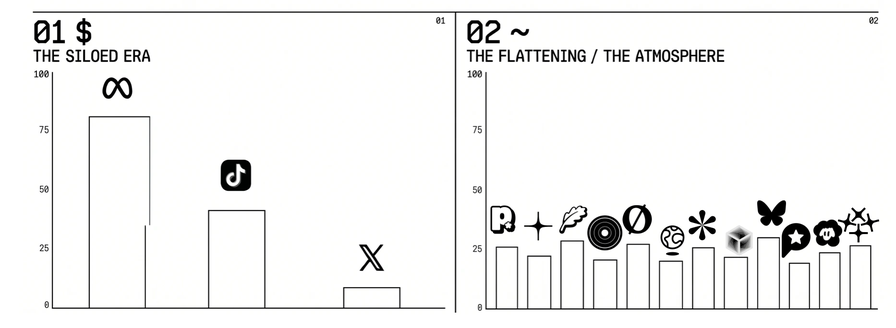
Who pays, who gets paid? This isn't a question Facebook, Substack or Twitter has to ask: each "owns the interface, graph, discovery system, analytics, payment relationship, and payout logic, so it simply declares itself the market. It takes whatever cut it wants and gives everyone else whatever remains."
On the Atmosphere, we have an "Atmospheric attribution conundrum" - for example: "Standard Reader provided the interface through which it was consumed. Bluesky or a custom feed may have helped the reader discover it. Infrastructure still had to index, host, and serve everything underneath".
Getting this right is the difference between two Atmospheres: one creaks along, relying on goodwill and public funding, the other thrives on a self-sustaining basis. I know which one I want to see.
Basser classifies the Atmosphere as "a four-sided marketplace ... On incumbent platforms, you typically have creators, the platform, and consumers. In the Atmosphere... the creator, the creation surface, the consumer, and the consumption surface can all be independent... [or] stacked, with a single app filling multiple roles".
Moreover, there's a fifth: "the discovery interface... [as] discovery can happen through many different interfaces while still pointing back to the same underlying identity, relationships, and content... The creator doesn't need to predict the one perfect interface through which their work will be experienced forever. Other people can keep building new doors into it."
Not only does this give creators more potential reach, but more people can innovate along this value chain: "New services can add discovery, presentation, context, moderation, commerce, or entirely new uses around the same work... The Atmosphere is unbundling the commercial machine of the platform itself", introducing "inter-app monetization".
This is quite revolutionary because today's "creator economy was never really built for creators. It was built for platforms", which is why most creators spend incredible resources trying to "escape the systems that made them visible" via "newsletters, private communities, courses, shops, merch...". The Atmosphere's interoperability means "everyone can specialize... [eg] Standard Reader ... creates value around writing it did not publish. The publishing apps create value without controlling every place their articles are read. Writers benefit from interfaces and discovery systems they did not have to build".
That won't happen, of course, unless every player in this ecosystem gets some reward from the role they've played. How those rewards are split should not be centralized - instead: "Publishers can offer terms. Apps can accept or reject them. Creators can choose" and disclaimers on commercial recommendations should be respected to not undermine trust. Each contribution should be "legible enough that participants can negotiate and markets can discover a price".
He then looks at the leverage each player has:
- "Creators ... produce the work people want. In the Atmosphere, they finally have the agency to match it", thanks to credible exit.
- "Clients ... control the consumption surface and often hold valuable off-protocol engagement data", important to "advertisers, publishers, and anyone paying for measurable outcomes"
- Those that influence discovery, like "Feeds, AppViews, and indexing services ... may be able to direct attention toward one piece of media rather than another", which gives them some leverage
- Others create value but don't have obvious leverage, like "Moderators, labelers, and trust-and-safety services"
Where is this heading? He suggests "collective markets... many independent participants could aggregate their inventory, demand, or bargaining power through shared advertising, subscription, commerce, or licensing markets". This will not necessarily be fair.
He also explores permission data, which will be very important to monetization: "A person might pay through one service and use that access through another", so monopolies cannot form: "Paid content would no longer have to be the point where the open social web abruptly becomes closed again."
This extends "beyond publishing... interoperable commerce: products and commercial relationships moving through the social graph rather than being trapped inside one marketplace."
Un such an environment few will raise venture capital "designed for ... companies that can capture enormous markets, own the customer relationship". Because the network is shared it cannot be a moat. "Instead of a few platforms capturing almost all the value, we could have many more apps, creators, publishers, feeds, communities, moderation services, and infrastructure companies each capturing a smaller, but still meaningful and sustainable, piece". While some businesses "need serious capital ... Video infrastructure, major AppViews, payment systems, ad markets, and developer tooling... the ecosystem should not depend on every successful company becoming a unicorn."
Not that this will be easy: while "Atproto helps solve the network cold start... [it] has not yet solved the economic cold start. We need to let apps begin earning from the value they create in the same way they can begin reaching users and content from day one" to get the flywheel turning.
The Atmosphere reaches a billion users when "thousands of apps, creators, and communities [see] a financial reason to bring their own part of the world with them."
He then makes some good observations about how "The economic layer should be built on top of atproto, not forced into the protocol itself" - while it needs "verifiable proofs that a transaction occurred. The money itself can move through competing payment systems... [so] multiple payment systems compete above atproto without recreating financial lock-in... Attested.network (by @ngerakines.me) is a great example of this approach".
Read the Full Post
The above notes were curated from the full post blog.joebasser.com/3msgtu45ir22f.Related reading
More Stuff I Like
More Stuff tagged atproto adoption , atprotocol , business model , joe basser , longform , social media , unfinished , permissioned data
See also: Bluesky and the ATmosphere , Content Strategy , Social Media Strategy , Content Creation & Marketing , Digital Transformation , Innovation Strategy , Social Web , Media , Business