
Curated Resource ( ? )
Practical Decentralization
Curated:
27/02/2026 from
www.pfrazee.com/blog/practical-decentralization
my notes ( ? )
Paul Frazee clearing up confusion surrounding Atproto, ActivityPub and Nostr. The latter two "are good examples of "federated hosts" and "magical meshes," ... Atproto draws inspiration ... but it works like neither".
Firstly, though, let's not put the cart before the horse: "The point of decentralization is to guarantee the rights of individuals and communities on the Internet... the average user doesn't care about decentralization... We use protocols to structure who can do what... about the how, but the consequence of the how is an authority model".
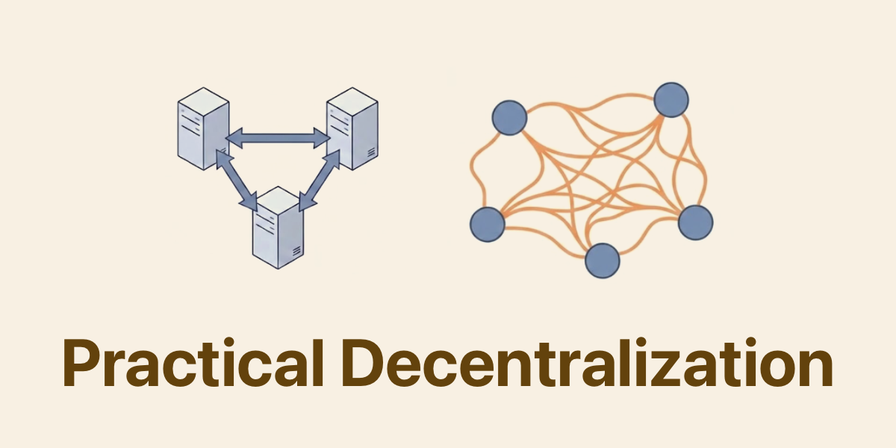
Federated hosts include email and ActivityPub, whereas "magical mesh model is what people think of with p2p and blockchains... eg BitTorrent, Bitcoin, Ethereum, IPFS, SSB, and Nostr... involve data being synced between user devices... [ATProtocol is] both. Or neither. It depends on how you look at it."
He introduces "
Information Civics... a practice of tensions [balancing] your ideological aims... a protocol that guarantees individual and community rights; [and the] need to produce usable software ... The initial atproto team spent 25 collective years on magical meshes ... [but] couldn't get past the problems of usable software. Good protocol design requires balancing the tensions of ideology and practicality."
p2p "has no answer for the governance of shared resources", which you need as soon as things scale up, because you "need to maintain indexes of aggregate data", and these shared resources need governance.
Federation is far more viable as it's "a free market solution to governance problems", But it introduces a "power problem. Popular instances become runaway winners." Moreover, "Traditional federation lacks modularity... a weak separation of powers - [users therefore can't] reduce the power of a popular instance by devolving specific functions to other providers".
In other words people get stuck in the popular instances, particularly as neither email nor ActivityPub allows you to migrate your content, although "I believe they're [ActivityPub] working on it".
atproto is a hybrid: "We took all our prior work on p2p and moved it onto servers". Results:
- "servers simplify operational challenges faced by p2p (reliable uptime, device sync, and key management...
- enabled the UX people expect ...
- User-addressed content ensures smooth migrations ...
- shared data space enables modularity, separating powers"
Because it looks like both of the other models, ATProto gets a lot of heat from both of them. But in the final analysis, protocols exist "To guarantee the rights of individuals and communities."
That's why self-hosting is "cheap to do... the PDS would actively take power away from the applications". But there's still plenty to do:
- "Bluesky is still too large ...
- moving PLC into an independent org (we're close!) ...
- Relays are now cheap, but large scale “appviews”" are not, so they're considering "open-sourcing our high scale backend.
- The revenue story is still unsolved."
Read the Full Post
The above notes were curated from the full post www.pfrazee.com/blog/practical-decentralization.Related reading
More Stuff I Like
More Stuff tagged activitypub , atprotocol , fediverse , nostr , paul frazee
See also: Bluesky and the ATmosphere , Fediverse